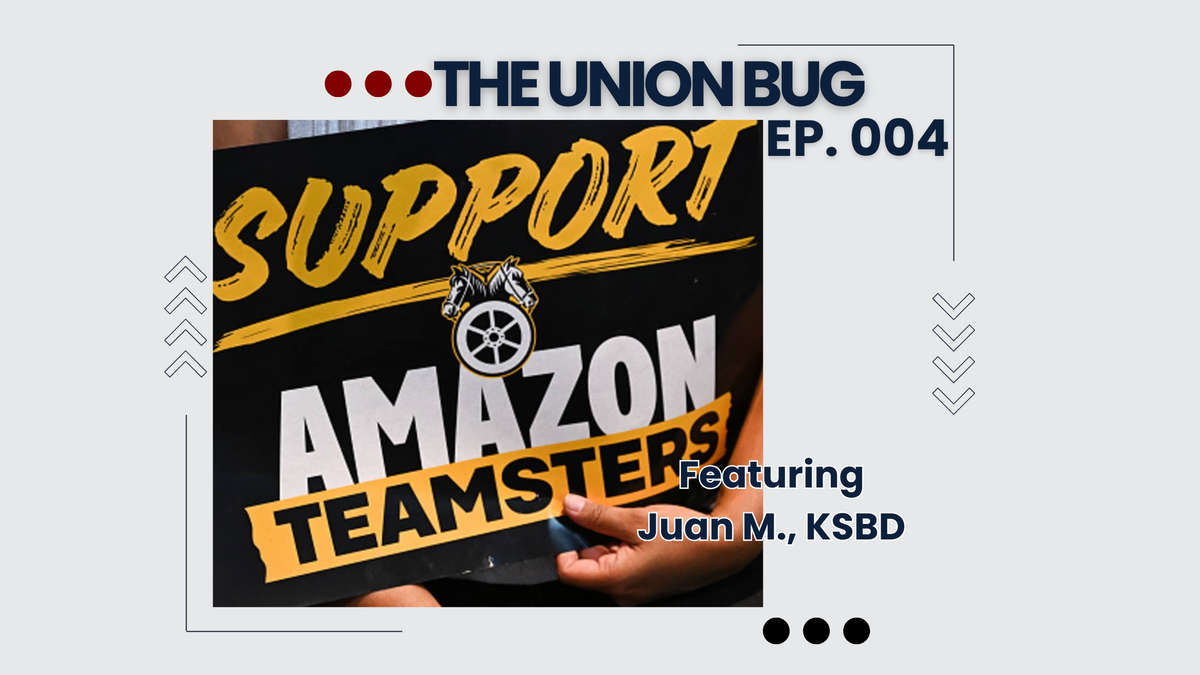
The Union Bug: Ep. 004
Lessons in Solidarity from an Amazon Organizer

[For those viewing this post via email, listen to the new episode here.]
Fresh off the latest national victory against Amazon’s failed Unpaid Time Off retaliation, I was keen to check in with Amazon Teamsters about how things were going with their campaigns. I caught up with Juan Mereles, Teamsters union member and docks department worker at KSBD, and Amazon Air Hub in San Bernardino, California.
On this episode of the Union Bug, we’re talking about the working conditions at Juan’s warehouse, organizing against a giant corporation like Amazon, living in the Inland Empire, and how best to build community with your coworkers and your neighbors.
Check out the Amazon Teamsters on Instagram.
Catch up with IE Amazon Workers here.
Host: Mel Buer
Production and Editing: Mel Buer
Episode Transcript
Below is a transcript of this episode. Please note that this is a rush transcript, and may contain errors and misattributed speakers.
00;00;11;03 - 00;00;36;18
Unknown
Welcome back, everyone to The Union Bug, a podcast by workers. For workers. I'm your host, Mel Buyer. The Union Bug is a podcast that explores what it means to work for a living in the United States and beyond, and what it means to organize for better working conditions at the shop floor and industry wide. This podcast is a proud member of the Labor Radio Podcast Network, with new episodes released every Monday.
00;00;36;20 - 00;01;10;22
Unknown
Fresh off the latest national victory against Amazon's failed unpaid time off retaliation, I was keen to check in with Amazon Teamsters about how things were going with their campaigns. I caught up with Juan Mireles, Teamsters Union member and docks department worker at CCPD and Amazon Air Hub in San Bernardino, California. On this episode of The Union Bug, we're talking about the working conditions at one's warehouse, organizing against a giant corporation like Amazon, living in the Empire, and how best to build community with your coworkers and your neighbors.
00;01;10;23 - 00;01;33;23
Unknown
Welcome to the show. Juan. Hey, Mel. Thank you for having me. I think a good place for us to start. And this is something that I say every episode, but a good place for us to start is just to get to know you a little bit better. So if you could just kind of introduce yourself, tell us when you joined Amazon and when you started organizing with the Teamsters and and kind of give us a little bit of your, your history there.
00;01;33;25 - 00;02;06;11
Unknown
Yeah. Yeah. Of course. I started working for Amazon late 2024. It was my first Amazon job, but not my first warehouse job. I'd worked at a couple when I was living in in Long Beach in Southern California. And yeah, my involvement with the union stuff actually came in not to not too long after I joined. I actually joined coincidentally just before they were going to start dropping cards for for Union Majority.
00;02;06;13 - 00;02;31;27
Unknown
And you know, I in a long supporter of unions, I have family who has history and unions and stuff and yeah, just like talking to my coworkers who I had met, like I'd met multiple people who were working numerous jobs while having to take care of their kids. And that, like, coworkers would actually cut some crazy horror stories of what it was like working in there.
00;02;31;27 - 00;02;49;04
Unknown
And when I heard about what was going on, I was like, yeah, I should I should get involved in this because it was it was it was kind of personal, you know, like, I live in the Inland Empire and like the Amazon, particularly in a lot of the warehouse, was kind of like taking over our region. And I was like, no, this is a good thing to do.
00;02;49;04 - 00;03;11;01
Unknown
So I got involved. For folks who maybe aren't fully aware, which there may be some listeners who aren't fully aware of what it's like to work in a warehouse, like an Amazon warehouse. Can you kind of outline a little bit what your day to day job is, you know, and what sort of things that you're responsible for. Your coworkers are responsible during a shift.
00;03;11;08 - 00;03;38;21
Unknown
Yeah, yeah. So the facility that I work at, it's called CCPD. We're an air hub. So we deal with air to ground, ground air freight. So while we don't have a lot of the same experiences that some, some of our coworkers that say, like the fulfillment centers or the sort centers do, we do still have a lot of pressure to make sure we're meeting time quotas that, you know, the planes got to go out on time, the trucks got to go out on time.
00;03;38;23 - 00;03;59;27
Unknown
So our day mainly consists of I work in the docks department. So I deal with the trucks, you know, offloading trailers, putting them onto conveyances, making sure that they get kind of to the departments that they need to go in a, in a timely order. And there's, there's often like really big time crunches. So we'll often have like management kind of breathing down our next to make sure, you know, we're moving targets fast enough.
00;03;59;27 - 00;04;33;24
Unknown
We're throwing boxes fast enough. We're building carts to put into the trailers that are going out fast enough. There's like certain departments where I've had coworkers who were like being denied breaks and stuff just because, like, the management was trying to meet a quota of making sure that these, these shuttles got built or so before the before, like the 10 or 11:00 time that they needed to be ready by pretty some, some pretty troubling story of like, even like a coworker who almost fainted because she was diabetic and was being denied a break and couldn't go up to go have some sugar or anything.
00;04;33;26 - 00;04;54;20
Unknown
But it's a pretty common, common story for a lot of us in there. Yeah, just like being overworked really quickly. Yeah, I would imagine there's a lot of weight that you're throwing around. What's the average you would say about pounds of of shipping items that you are throwing from truck to, you know, the warehouse behind you and vice versa.
00;04;54;21 - 00;05;24;13
Unknown
Yeah, yeah. So Amazon has a cap on, well, at least my facility, there's other facilities that deal with like larger freight. But my facility has a cap on like packages can only be up to about 50 pounds. So it's a manageable weight if you look at it just individually. But with the amount of boxes we're moving per hour for even 15 minute segments, like bending down repeatedly to pick up 50 pound boxes like immediately takes a toll on your body.
00;05;24;14 - 00;05;45;03
Unknown
I had a buddy of mine who once did the math and it like was over like 8 or 9000 pounds that we move a day, maybe even ten, because yeah, at my facility they break things down by like 15 minute segments, and they want us to actually throw 1500 packages every 15 minutes. So man. Yeah, a lot of, a lot of intense like back work.
00;05;45;04 - 00;06;11;24
Unknown
Right. And how many guys are usually on a crew per shift? My department in docs, I think we run on a crew of around 40 to 50 a day oper shift with other departments having similar number with, I think one department being a little bit more. But that's not to say that everyone who's on that shift is is throwing like they usually have, like a good majority of people with pallet jacks and moving go karts from one place to another.
00;06;11;24 - 00;06;38;02
Unknown
And then like a smaller number of people throwing the boxes. Yeah. So I mean, that's still that's a lot of work to do for 8 to 10 to 12 hour shift. And I think a good question to ask is, you know, when you are getting engaged in shop floor organizing, particularly within your department, but also, you know, within the warehouse itself.
00;06;38;03 - 00;07;04;04
Unknown
What are some of the you've already mentioned that, you know, management likes to throw around break privileges, which is not cool, but are there other things that sort of even as quickly as you got in there and started organizing, were there items or things that you noticed during your day that you thought, you know, wow. A union would be really good to help us manage this in terms of working conditions, pay, benefits, whatever.
00;07;04;06 - 00;07;30;29
Unknown
You know, what is something that is really kind of stuck with you as kind of an organizing point for yourself and for your coworkers? Yeah, yeah, I think the two big ones really boil down to to pay and the safety. Like I alluded to it at the beginning, like I have a lot of coworkers who are working multiple jobs, like, I can't tell you how many of my coworkers tell me that they have actually strained relationships with their kids or with their partners because they have to be working so much just to be, just to keep a roof over their heads.
00;07;31;04 - 00;07;49;04
Unknown
The region that we're in, the Inland Empire, was at once the place that people went and moved to when they were getting priced out of other regions. But now things here are getting incredibly expensive. So the cost, the cost of living is definitely a big issue here. But yeah, going back to the other one is a lot of its safety.
00;07;49;05 - 00;08;20;16
Unknown
Like we talked about like throwing boxes. There's numerous coworkers who sustain like back injuries. When you're moving go karts you typically you can only push them with one side of your body. So you're putting a repeated stress on one side that has led to certain people having again, like back and spine issues. Just recently we've had to do certain marches on the boss because of because we have these things called infinity bags, which is where we put a lot of the small packages into, and they have mold on them.
00;08;20;16 - 00;08;41;07
Unknown
And there's people who are experiencing symptoms of like, you know, lightheadedness. I think one coworker at least passed out. And just like nausea feelings. So yeah. So there's a lot of there's a lot of ways in which management at Amazon literally just treats us as, as numbers in ways that they just want to make sure that they meet their quotas.
00;08;41;09 - 00;09;09;01
Unknown
A story from even before I got in there that I have heard repeatedly told me was for folks who don't know. Again, the Inland Empire is very dry, almost like desert region. We're prone to a lot of fires. And the summer before I started working there, there was all these wildfires going around in the area and us being an air hub, we have a certain section of workers who are working out on the ramp with the airplanes, and the smoke was incredibly bad.
00;09;09;02 - 00;09;39;06
Unknown
People were coughing up like black sludge, people passing out and all the other workplaces in the region or in the area, sorry, were closing down for the time because of how unsafe it was. But Amazon, at least in the KBD, was not. They were handing out like N95 masks and making people sign waivers saying that if you take your this at 95 knots, your understanding that it's actually not going to do anything for the smoke, it's not built for smoke.
00;09;39;06 - 00;10;00;16
Unknown
So basically just saying that you're agreeing to work in these conditions without protection. And it was a bunch of my coworkers who actually were incredibly fed up and held a huge delegation of, I think, almost like 100 workers who marched on the boss and told them that this were these were unsafe conditions, that people were passing out, that people could be facing lifelong health, health injuries and health risks.
00;10;00;16 - 00;10;14;25
Unknown
And they did get them to shut the building down for two days with pay. And it was like stories like that that I was like, this is why we need a union. Because like, our management does not care about our long term safety. They don't care about our long term health. They don't care about our long term financial health.
00;10;14;28 - 00;10;42;27
Unknown
It's only when we get together and we take collective action, that we're able to actually force the company to care about us, right? Well, you know, it's unfortunately all too common to hear stories about particular Amazon warehouses and management at these warehouses being faced with a climate or ecological or whether crisis and choosing to remain in operation. I mean, you hear about the warehouses that were hit by tornadoes in the Midwest.
00;10;42;27 - 00;11;15;24
Unknown
You hear about warehouses that didn't shut down during super severe weather in the South, you know, and people got hurt and people died, you know, and so it's unfortunate that the the immediate response I have is, well, par for the course for that corporation. You know, that this is what they do to their workers, you know, and and more power to the workers who actually collectively organized and said, actually, no, we're going to close the doors here because this is not solid.
00;11;15;26 - 00;11;54;09
Unknown
Right. And I think that's a really important story, you know, and the something that I've been interested in and I'm sure most of the internet has been interested in, as you know, there was a warehouse fire in Ontario and it brought up a lot of conversations. This is Ontario, California, for listeners who are not in Southern California. It brought up a lot of conversations about the Inland Empire and about sort of the warehouse takeover of much of the Indian Empire and how it has become this sort of situation where not only are residents getting forced out or areas being gentrified into these manufacturing districts, right?
00;11;54;12 - 00;12;21;26
Unknown
Gentrified is maybe not the right word, but, you know, these manufacturing districts are essentially colonizing the area and turning the whole place into blocks and blocks and blocks of warehouses, and how that's impacting the quality of life for a lot of people in the area. And you've talked about this a couple of times already. But, you know, I think it's worth kind of taking a moment to really talk about what that's like living in the Inland Empire and how that's maybe affecting the way that you're approaching organizing.
00;12;21;26 - 00;12;43;26
Unknown
You've already discussed how wages are too low and that many of your coworkers are having to work multiple jobs in order to be their families. You know, and yeah, so I think maybe we can kind of explain that a little bit more to our non Southern California listeners. I'm here in Los Angeles, you know, and hear these stories quite often.
00;12;43;29 - 00;13;03;29
Unknown
And to really kind of see, you know, let's, let's thread that into our discussion of why it's important to organize these places as a way to hopefully kind of list the tide a little bit. Yeah. So I mean, like, like you're alluding to like the Inland Empire is have been dubbed, you know, the warehouse capital of the world.
00;13;04;00 - 00;13;37;27
Unknown
We are one of the major logistics centers of the entire country, over 40% of packages that not only Amazon, but I think just like nationally, that travel through the United States, travel actually through the Inland Empire. And so the warehouses have kind of become like a permanent staple of life here, often bringing low paying jobs like we've talked about, but also just increased air pollution inland has, I think, like seven times the asthmatic rates of almost any other region in the country or the national average, rather.
00;13;37;29 - 00;14;02;09
Unknown
So the air quality is bad here. You know, we're having warehouses and trucks driving by elementary schools, middle schools, family homes. So it does it makes it's making the area incredibly unsustainable to live in, both like in a financial sense and just in a real like holistic sense in which, like, our bodies are breaking down because of the environment that's being created by these warehouses without oversight.
00;14;02;09 - 00;14;20;21
Unknown
And yeah, I know that. I know that story that you're alluding to about what happened in Ontario. And I think a lot of our coworkers, a lot of our coworkers were talking about it because, I mean, it's it's truly it's a truly sad thing that, you know, these desperate conditions have led someone to such a desperate action. Yeah.
00;14;20;23 - 00;14;41;12
Unknown
To be clear, I'm not endorsing such an action. I think online when when it came out that this warehouse fire was arson, my immediate response was, hey, guys, maybe we could organize a union instead. You know, like, there are other options that you could take before you you had in such an extreme direction. And you know, exactly. That's what we're going to do.
00;14;41;13 - 00;15;01;00
Unknown
You know, we would rather organize than reach the point where you set $650 million worth of product on fire, you know, 100%. The only thing that's actually going to help us better conditions, help us make sure that we have living wages, that we have some modicum of control over. The air quality in our region is sort of taking collective action and organizing our workplaces.
00;15;01;00 - 00;15;27;07
Unknown
And Amazon being one of the strongest and biggest employers out here, like Amazon, it's all the more reason to be organizing within Amazon and putting actual collective pressure on the company as opposed to, you know, individual actions. Like there's so many people who are fed up and really aggravated, you know, feeling like they're at the edge of a cliff because of the of of where their workplaces are pushing them to.
00;15;27;07 - 00;15;49;15
Unknown
And if we're able to reach out to these folks and say, no, like, let's build together, let's join together, let's organize together and talk with our coworkers, because that's where we're the strongest. These companies, they can they can take certain financial hits, like losing a property or something like that. But when it's when workers are actually able to, you know, go on strike or walk off the job, that's and recognize their actual power.
00;15;49;16 - 00;16;27;16
Unknown
That's when the companies actually start crumbling. Yeah. Agreed. Certainly that is the conversation that a lot of folks are having. It's like, well you know, these multi-billion dollar companies do have insurance for product loss right. But they often don't know what to do in 400 warehouse workers get together and say we're we're walking off. Right. And, you know, I think I think you brought up a really good point, too, but about just the conditions in general, I think, you know, you can feel really the whole country kind of simmering as conditions are getting worse, particularly as this war continues.
00;16;27;17 - 00;16;51;08
Unknown
Gas prices get higher, which in California are even higher. Folks are really starting to feel a squeeze here. And, you know, we hope as organizers that this can become a space where you can start to have those hard conversations about organizing, and you can start to really talk about you feel it in your wallet, you feel it in the way that you are going to the store.
00;16;51;09 - 00;17;20;09
Unknown
You feel it in the strained relationships with friends, with coworkers, with family members. Right? This is a space where you can start to say, if the pressure is on for us, the pressure is also on for them. So let's get together and try and raise that pressure even more and help each other out and reach a point where we can really kind of improve our working conditions, improve our pay, especially for a company like Amazon that posts billions of dollars in profits every year.
00;17;20;10 - 00;17;46;25
Unknown
Right. And, you know, I think it's I think this particular struggle with the Teamsters at Amazon is similar to the one at Starbucks is similar to the one that, you know, even the coffee workers at Blue Bottle who are taking on Nestle. Right? These these sort of David and Goliath stories are, are, you know, the ones that really are going to be sort of historical, right?
00;17;46;27 - 00;18;12;10
Unknown
Because we're talking about these corporations that previously multinational corporations that previously felt untouchable, right, that they can just do whatever. And the case is that's not always the that's not true, right? That when workers can organize collectively, they really do have a shot at winning something important, you know, and putting these corporations on the back foot. Right? Yeah.
00;18;12;15 - 00;18;41;20
Unknown
Yeah, it's making me think of a couple things. First, to touch on like the rising oil and gas prices because of this war. Like that's something that definitely a lot of our coworkers are feeling. I mean, we've already seen housing prices go up, but like now we're seeing gas food starting to skyrocket. And especially with with how many like warehouses and things there are here in the Inland Empire, like good jobs are or slightly higher paying jobs, I might say rather are a lot harder to come by.
00;18;41;21 - 00;19;03;05
Unknown
So we actually at my facility, we have workers who are driving over an hour to get to speed and, you know, with gas at $6 a gallon like that, that quickly starts taking hit that at one point you're spending an hour or two of your of your labor inside the shop just paying for the gas to get there at home.
00;19;03;07 - 00;19;21;04
Unknown
So that's that's something that a lot of our coworkers are facing. But I do really appreciate you you connecting this with some of the other struggles, particularly some of the more historic ones, like one that I like to think back to a lot because something that our coworkers often bring up is this David and Goliath thing. You know, Amazon is such a huge company.
00;19;21;06 - 00;19;44;16
Unknown
Amazon is so powerful. How can we actually win this? But history has shown us that it's possible. You know, nobody thought that the auto plants were going to be able to be organized until UAW had their sit down strikes for union recognition back in the 30s, and they did it at a time where we actually had less union density than we have today, and no legal right to do so.
00;19;44;16 - 00;20;11;23
Unknown
So we're in a better position now. We have more rights that are recognized now. And they were able to jump from membership from like I think it was like 40,000 in 1 year to like 300,000 in like one calendar year later. Because like of just how much of an inspiration this can be like I think like, yes, we are organizing at a few key facilities here in the i.e., but like once I think like people can really see that this is possible.
00;20;11;24 - 00;20;38;20
Unknown
Like this is going to catch like not to make a pun on the Inland Empire but like wildfire, you know. Yeah, I think like the more we continue to organize, the more victories we have. We have now a few facilities here in the Inland Empire who have organized, who have reached union majority. And the more that our coworkers see us winning and see the building build the movement building, the easier it's going to be for them to see that finish line of, oh, we can win, which we know truthfully to be, to be the truth.
00;20;38;20 - 00;20;57;28
Unknown
We can write. We will. I think one thing that I hear a lot from some of the younger workers that I talked to, especially my, my union of the News Guild, which has its own fights. Right. We're not organizing necessarily on a scale of warehouses, but, you know, we are organizing shop, shop. And there are some folks who say this takes forever.
00;20;57;29 - 00;21;29;01
Unknown
What do you mean? This campaign is going to take us six months, a year, two years, three years, whatever it is. Right. And then we have to wait for for the bargaining to happen. And, you know, folks don't tend to take a long view of what that securing those gains mean. And especially when you're going up against a company like Amazon, for example, you know, these big conglomerates that really like to play hardball and try to ignore the reality that there are there's organizing happening, and the law requires them to pay attention.
00;21;29;04 - 00;22;03;00
Unknown
What do you say to those those workers who maybe are a little impatient or are struggling to sort of take this long view? Yeah. What I would say is that every single day in there in Amazon, we're already seeing, you know, workers getting exploited. We're seeing people losing their jobs over, over little things. People like like with it earlier being treated like number two or disposable every day that we're in there and we're not organizing, we're already losing like so many coworkers are, like, oh, I don't want to do this because I don't want to lose my job.
00;22;03;01 - 00;22;25;10
Unknown
Amazon can fire you for anything already. Like, that's that's been their Mo. That's that's why they have one of the highest turnover rates of almost any company. But it's only through doing something, doing organizing, doing something collectively that we have a chance at winning. If we do nothing, we're we're going to lose regardless. But if we if we get together and we organize, that's where we have a chance.
00;22;25;10 - 00;22;45;19
Unknown
And yes, it may take some time, but like we're the ones that are, our lives are really on the line, like being able to like stay within our house. Like I think like we are our our coworkers are more willing to fight because we have more on the line. Whereas for someone like Jeff Bezos, it just means like if he loses this fight, this means that he loses a few yachts.
00;22;45;19 - 00;23;02;28
Unknown
This means that he maybe can't take as many international vacations a year, you know? Right. For so many of our coworkers, this really is like the fight of of our lives, of, like having our lives with dignity. Well, and the struggle is worth it no matter how long it takes. Right, exactly. Even in the face of potential failure.
00;23;02;29 - 00;23;37;00
Unknown
Right. You know, moving the needle in one in the direction of equity, of dignity in the workplace is worth that effort, you know? Yeah. Especially with, like, how much things we see coming down the pipeline with like, AI already coming for a lot of our jobs, for automation coming for a lot of our jobs. Like there's things on our horizon that if we don't start organizing and doing and building collective power now that we're going to be on a lot worse of a foot than when those things start getting rolled out in a larger in, in a larger capacity than they already are.
00;23;37;06 - 00;24;08;12
Unknown
Yeah. Well, you know, I do want to take a moment to sort of highlight some of the ways that the Teamsters have had in the realm of Amazon. You know, one of these wins doesn't apply necessarily to your where shop. But, you know, on Staten Island with JFK eight, they have won the right to bargain from the NLRB after a long fight, which hopefully will have these sort of trickle down effects to be able to to to push something similar in your workplace and other warehouses around the country.
00;24;08;16 - 00;24;34;14
Unknown
Another huge win that I reported on the other day, about a week and two weeks ago, was about the settlement for unpaid time off for every Amazon worker nationwide, which was a huge win for folks who maybe don't know where Amazon workers, Amazon Teamsters were walking off the job. What was it, 2024 during the Christmas holidays? On one day or two day or three day strikes?
00;24;34;16 - 00;25;07;28
Unknown
Really trying to highlight bad working conditions, union busting efforts by Amazon, a number of things. Right. And they tried to hit him where it hurts during the holidays, which I thought was a very important and good strategic move. Management, in response, began claiming that this time that they took walking off the job took took docked points away from your finite amount of unpaid time off that each worker is allotted.
00;25;08;00 - 00;25;38;02
Unknown
And the Teamsters took that to the NLRB and said, that's retaliatory and not cool. And the NLRB agreed and ordered Amazon to reinstate those docked points and not do that again. So how do you feel about that when, you know, in the last couple of weeks coming off that win? And what does that meant for, you know, strategic sort of organizing in the workplace as you're looking forward to potential further collective action in the future?
00;25;38;04 - 00;25;56;23
Unknown
Yeah, yeah. No, that was an amazing win. Like that's one that we had all been been pushing for for a long time. And truthfully, a culmination of, yes, like the Teamsters and the NLRB fighting at the at the federal level. But also just like all of our organizing on the ground level, continuing to put pressure on the situation.
00;25;56;23 - 00;26;24;07
Unknown
So I think it's a victory that we can all claim collectively. But it's been an amazing feeling. So many of my coworkers have been just elated. You know, I have. I had coworkers who, because Amazon took their up for going on strike, like, had to miss out on really important life events, like the loss of of a loved one or something and truly like devastating things.
00;26;24;08 - 00;26;42;14
Unknown
And so getting these hours back has been has been incredible. And as far as your other question, like, I think that this this is honestly something that has quelled so many of the fears that are a lot of our coworkers have because, like, you know, first, the question was that when we were talking to our coworkers, like, if you go out on strike, will you get fired?
00;26;42;14 - 00;27;01;08
Unknown
And then, you know, we went out on strike and we came, we all came back in and none of us got fired. Even the folks who they tried to fire because of negative upt, we were able to get them to fight, to get their jobs back with back pay and get them reinstated. But then also the following question was always like, oh well, I can't afford to lose these hours.
00;27;01;08 - 00;27;25;06
Unknown
And we all knew in our hearts that and in our minds that that taking the upped was a retaliation and that we were going to fight against it. So now for all of our coworkers who had hesitations about I can't go out on strike because I only have X amount of hours, we all know now, and we can recognize that when we worked collectively, like we can we can protect our rights, we can protect our hours.
00;27;25;06 - 00;27;43;12
Unknown
And that there's that there's safety in numbers, that there's safety in us working collectively. Yeah, there's a lot of coworkers who are who may have had certain hesitation before. So are now asking us like, oh, this is really sick. So when are we going to walk out? Like, when are we going to do something about this? Like, this is tight.
00;27;43;13 - 00;28;06;17
Unknown
And yeah, so it's been a big momentum wave that's been carrying through a lot of our conversations. Yeah. Talk about David and Goliath. You know going up against a monster and winning I mean this is an incredible win. And I wrote about this in my article as well, that it really wouldn't have been possible without the sustained organizing from the rank and file.
00;28;06;18 - 00;28;32;24
Unknown
While the Teamsters lawyers were working their way through the NLRB. Right. Because, you know, you get a bunch of workers who are consistently marching on the boss asking about this particular issue. Management starts to get pretty squirrely, you know, and starts walking up the ladder because they can't handle it. Right. And, you know, truly a monumental win and really kind of climb back what's fucking owed to you.
00;28;32;24 - 00;28;53;25
Unknown
And really it's fantastic work, you know. And I really do think as I've spoken with other Teamsters recently, you know, it does have knock on effects all the way down the line. Right? Because you get that confidence, you get that ability to say, look, we engaged in solidarity and collective action and you got what you needed, right? You got your hours back, you got reinstated.
00;28;53;25 - 00;29;14;21
Unknown
And we did that, you know? And that is incalculable in the sort of long term strategy of organizing a place like that. And it's just a huge, like moral victory that our coworkers really see because, like, there's always been an understanding that like, like has been said earlier, that Amazon can fire you for just about anything that they want to it.
00;29;14;23 - 00;29;50;02
Unknown
They'll always find some excuse, but just to see that it's us as a union. Like I don't want a third party of the union. The union is us who are on the ground. I mean, it's a national structure, obviously, but, you know, it is us on the ground who are making it happen, who are acting as a union, who are who are the ones coming to the fence of every coworker who gets fired for some BS reason, who are coming to the sense of workers who are being made to work in unfair conditions like Amazon lost the moral fight years and years ago, and rulings like such as this just show us that like we're
00;29;50;02 - 00;30;13;27
Unknown
also continuing to win the bigger fight too. Yeah. So what are some other prerogatives that you think are important in sort of future organizing your shop or, you know, are there certain strategies that you found to be particularly useful as you continued your day to day organizing? For example, the marches on the boss seem to be particularly successful for Amazon workers.
00;30;13;27 - 00;30;35;28
Unknown
You hear a lot about them engaging in that sort of collective action as a tactic, and that it does get results in a way that you maybe don't hear at other workplaces. Is there anything else that you've kind of tried or experimented with as you've continued organizing that you think is important for maybe young or young or new organizers to potentially try in their own workplace?
00;30;36;00 - 00;31;04;25
Unknown
We have this like saying in a lot of organizing circles about like organizing the whole worker. And I think it's important to recognize a lot of the conditions that we're facing inside the warehouse. But also, just like on a bigger sense and how we can connect those together. Like to give you an example, like right now at my facility and a few other facilities in the Inland Empire, is is a place that has a lot of is largely built up by immigrants.
00;31;04;25 - 00;31;38;12
Unknown
So we have a lot of coworkers who are really scared and agitated around ice coming into different workplaces, warehouses. And so we've actually built campaigns around, like an ice out of Amazon campaign that has been able to speak to workers in such a in a broad way that maybe some things like, like just cause or a pendant aren't speaking to them at this one moment, but because we allowed ourselves to look at like the bigger picture, what are these workers facing in a grand scale of things?
00;31;38;18 - 00;32;00;26
Unknown
This petition, this campaign has been incredibly successful, and we've been able to activate workers who were either, you know, semi like kind of lukewarm on the union or maybe even against the union, like if you can show the workers that the union is here to interact with all the issues that that we're facing inside the shop, because if ice were to come into the warehouse, then that becomes a workplace issue.
00;32;00;26 - 00;32;30;29
Unknown
And so the union needs to have a voice in that, right? Yeah. So that's that's the the only other thing that I can add, I think, you know, continuing to talk to all of our coworkers, really getting to know them, getting to know what's the issues that they are passionate and caring about. Because we can only move the we can only move efficiently in large numbers if we have the largest amount of buy in from our coworkers, like our coworkers are not going to move around an issue that they don't care about.
00;32;30;29 - 00;32;51;21
Unknown
And so having that deep trust and understanding of our coworkers and what they're actually dealing with and facing is, is like the most crucial of any of the steps. Yeah. Can you speak a little bit to sort of union as community, coworkers, community, you talk a little bit about, you know, organizing to the whole worker, but also, you know, I think that reaches outside of the workplace as well.
00;32;51;24 - 00;33;31;15
Unknown
And being able to kind of create the space outside of the workplace that allows you to sort of build community with your coworkers, with other union members. And, you know, we are blessed to live in California, in Southern California, that has a very strong labor movement, that has a lot of inner union solidarity. But, you know, you talk you talked at the top of this conversation about coming from a sort of labor oriented family and being able to sort of, you know, have that recognition and experience going into your own organizing, you know, can you speak just a little bit to to how you sort of build that consciousness, but also really build those relationships
00;33;31;15 - 00;33;52;15
Unknown
with your coworkers when you're not standing on the shop floor? And how to sort of strengthen that sense of solidarity and community, really, in all aspects of your life. Yeah, I think that as, as we we organize within the shop and our coworkers see who is like standing next to them when they're taking on the fight against their boss.
00;33;52;17 - 00;34;08;15
Unknown
They all they're also seeing who standing next to them, who can be a person that's reliable and can be called upon when they need something else in their lives. I think that the organizing that we've done has built such a tight knit community that I have, you know, have coworkers who we've probably known each other for a handful of months.
00;34;08;15 - 00;34;26;25
Unknown
But because we've been through this struggle, they're calling me up when they have family issues or when they're having certain, certain struggles that they're going on because they know that the people who are they know that us doing the organizing work comes from a place of care. And this cares what helps build the foundation of a community around us.
00;34;27;01 - 00;34;52;11
Unknown
And not only that, like even doing certain, some of the organizing winds have actually even been used to help strengthen other communities spaces. Like one of the wins that we've had was that we we learned a couple of years ago that Amazon was essentially committing wage theft against us by neglecting to give us third breaks. And if you work over ten hours and you don't get a third break, they're supposed to pay you an hour's wage.
00;34;52;12 - 00;35;13;27
Unknown
And we ran a huge campaign on it. We actually got Amazon to to acknowledge that they did that and create a portal on their website for people to start submitting claims for all the days that they worked over ten hours and didn't get a third break. And we had coworkers who who got back thousands of dollars. This is like life changing things that happened to so many.
00;35;13;28 - 00;35;43;23
Unknown
And one story that particularly rings out to me is like, I have a coworker who comes from an immigrant background who goes to a church whose the constituents are largely from an immigrant background. She got back like 8 to $9000. Wow. And because of that? Yeah, because of that, they were able to create a fund within her community church for legal, legal representation in case there was ever any case like Ice ever picked up any of their congregation.
00;35;43;23 - 00;36;06;22
Unknown
But yeah. Yeah, I think like the union work of building of of doing solidarity of of of being there for each other is the foundation that so many communities are built on. And just to see it continuing to grow within our spaces, but also how that can even reflect in the spaces outside of there are only more, I guess tangentially related to us is is really a beautiful thing.
00;36;06;23 - 00;36;31;17
Unknown
Yeah, I really appreciate that you bring up that. A lot of this comes from all of it comes from a place of care. We care about ourselves. We care about our coworkers. We care about our families. We care about our dignity in the workplace. And, you know, I think in this current moment with authoritarian authoritarianism just here and wreaking havoc on our communities, right.
00;36;31;18 - 00;36;55;19
Unknown
Truly the sort of true revolutionary, the true radical act is to be a caring neighbor, right? And to really build these communities of care. And the labor movement has a place in that. Right. And it starts on the shop floor, just like it starts in the Amazon. It starts in my shop floor. And and I think that's a really important thing is, you know, the baseline for all of that is that you give a shit.
00;36;55;24 - 00;37;19;15
Unknown
You know. And I think that's really beautiful that you, you and your coworkers and the rest of your, your brothers and sisters in Amazon and elsewhere have really built that space and continue to build it and strengthen it, you know. So any final thoughts that you have? I don't know if there's anything else that that I would want to add about my, my own experience.
00;37;19;15 - 00;37;38;00
Unknown
I think we've covered it pretty in length, but I would just implore anyone to listen to this, that if you know, if if you're in a workplace that's not unionized, start talking to your coworkers and start getting organized. If you're in a union, like get involved with your union, make your union. If it's not a fighting union, make it into a fighting union.
00;37;38;00 - 00;38;00;13
Unknown
Because I think, like as you said, like with all these encroachments that are happening on our rights, those both on the shop floor level, but also in in the more societal level, it's only through building powers in our workplaces and building powers in our communities that we're going to be able to have a fighting chance. And so, yeah, that's that's what I would employ to everyone get organized.
00;38;00;14 - 00;38;25;16
Unknown
Where can folks find updates about the Amazon Teamsters, or do you have a social media account for your local, or for the sort of wider movement that folks can kind of check in on? What's going on with your organizing? Yeah, yeah. So there's for Amazon Teamsters in general. There's the Instagram, and I think maybe the Twitter handle too, of just Amazon Teamsters.
00;38;25;17 - 00;38;46;11
Unknown
If you're interested in ever just finding out about what's going on specifically with like us down here, we have an Instagram page and a Twitter page called i.e. Amazon Workers, where you'll get to see a lot of the ongoing what's what we're doing down here in the Inland Empire. Thank you so much for coming on the show on, and I really appreciate you taking the time.
00;38;46;13 - 00;39;04;13
Unknown
I always appreciate the perspectives of of brothers and sisters in the movement. And so it's been really good talking to you. It's been great talking to you. Thank you. Thank you for having me on. That's it for us here at the Union Bug this week. Once again, I'm your host, Mel. Thanks again for your continued support and solidarity.
00;39;04;13 - 00;39;26;22
Unknown
I am so grateful for your listenership. If you're interested in supporting the podcast, you can head on over to Words About Work News and subscribe to the newsletter at any tier. If you'd like to support this project financially, you can do so via the about page for as little as $5 per month. Paid subscribers will get early access to new episodes every Sunday starting in May.
00;39;26;29 - 00;39;36;18
Unknown
Otherwise, you can find new episodes of The Union Bug wherever you get your podcast dropping every Monday. Thanks again for listening and I do hope you'll stick around. Until next time.